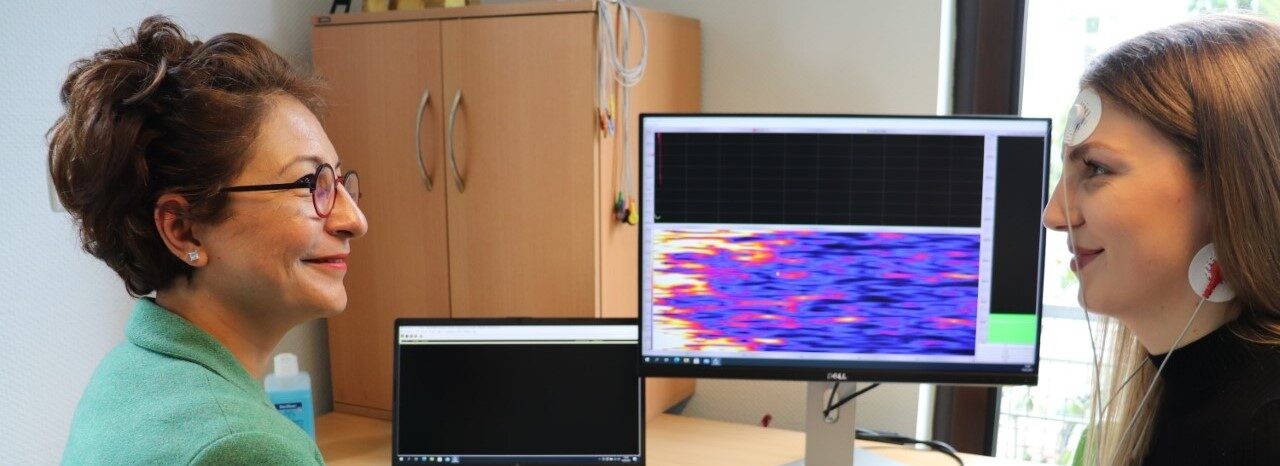
Neurofeedback & Biofeedback and weight loss
Sustainable change in the nervous system begins

Eveline Hedtke
Neurofeedback specialist

Neurofeedback & Biofeedback and Weight Loss
Why Sustainable Change in the Nervous System Begins
Neurofeedback and biofeedback are often misunderstood.
Some think they are esoteric, others a modern "miracle cure."
Neither is true.
Neurofeedback and biofeedback are scientifically validated training methods that help the brain and body return to a state of self-regulation. And that’s often where a change begins that surprises many: the weight regulates itself.
Losing weight is rarely just a matter of diet
Most people who struggle with their weight know very well what they should eat.
However, the more crucial question is: Why does the body keep craving more?
Common causes include:
chronic stress and persistently elevated cortisol levels
shallow or dysfunctional breathing
emotional suppression
a constantly active fight-or-flight system
eating as a means to regulate stress or emotions
In these cases, weight gain is not a sign of lack of discipline.
It is a biological adaptation strategy.
The body is trying to establish safety.
A Case from Practice: When Regulation Changes Everything
A woman came to my practice with her daughter.
She had researched extensively and was looking for an alternative to medication treatment for anxiety. She wanted to strengthen her child's nervous system, not suppress symptoms – neither with Ritalin nor with beta-blockers.
The daughter was very tense during the first session and initially refused the sensors.
So we altered the approach.
I suggested connecting the mother first.
During the session, the daughter observed how the mother's breathing changed, how calmness emerged, and the body visibly regulated. Without pressure, without persuasion.
This modeling of safety worked.
Shortly thereafter, the daughter wanted to try it herself.
Both came regularly over a longer period.
The results were clear:
the daughter's anxiety decreased significantly
school life became more stable
emotional regulation improved sustainably
But the change did not end there.
When the Nervous System Regulates, Eating Behavior Changes
After some time, the mother also began using neurofeedback.
Without a diet.
Without prohibitions.
Without compulsion.
Her eating behavior changed almost incidentally.
The body no longer needed food as compensation for stress or inner tension.
Within six weeks, she lost 8 kilograms.
Even more importantly:
her relationship with food normalized
her stress tolerance increased significantly
her self-perception changed
With increasing inner clarity, she made decisions more consciously. Relationships were reassessed. Changes occurred not impulsively, but from a place of stability.
Why Neurofeedback & Biofeedback Support Weight Loss
Neurofeedback and biofeedback address where many classical weight loss programs do not reach: in the autonomic nervous system.
They help to:
reduce chronic stress activation
improve emotional regulation
normalize breathing patterns
decrease impulsive eating
reconnect with natural hunger and satiety signals
Weight loss is thus not forced.
It emerges as a result of balance.
No Magic – Just Functional Biology
Neurofeedback and biofeedback do not change your personality.
They reduce the constant background noise of stress.
When the nervous system feels safe:
the body stores less "for later"
cravings decrease
digestion improves
decisions become clearer
That’s why many people report not only weight changes but also better sleep, more stable relationships, and improved quality of life.
Not because something magical happened –
but because the body was finally allowed to stop working against itself.
Conclusion
Sustainable weight loss rarely has to do with control.
It has to do with regulation .
Neurofeedback and biofeedback offer a structured, scientifically validated way to bring the brain and body back into balance – so that healthy behavior becomes not a struggle, but a natural process.
When the nervous system learns safety,
the body follows.