Neurofeedback for PTSD & Trauma in Berlin | Process traumatic experiences, find inner peace
When the past won't let you go – how neurofeedback can help you process trauma and win your life back

Eveline Hedtke
Neurofeedback specialist

When your body cannot forget
You have experienced something that changed your life. A situation that overwhelmed you, made you feel powerless, and still won't let go of you today. Maybe it happened years ago, but it feels like yesterday. You wake up at night with a racing heart, in the middle of a panic attack. Certain smells, noises, or places immediately plunge you back into that moment. You avoid situations that could remind you of what happened – and your life becomes increasingly smaller.
This is not a weakness. This is a normal reaction to an extraordinary event. Your brain tried to protect you – but it got stuck in a state of permanent red alert. Your nervous system reacts as if the threat were still there.
This is called PTSD – Post-Traumatic Stress Disorder. And the good news is: your brain can learn to return to a state of safety. Neurofeedback is one of the most effective methods to process traumatic experiences – without having to expose yourself to the trauma again.
What happens in the brain during trauma?
During a traumatic experience, your nervous system is flooded. Your body reacts with a massive stress response – racing heart, adrenaline, all senses are sharpened. This makes evolutionary sense because it helps you survive. The problem: for some people, the nervous system remains stuck in this alarm state, even when the danger has long passed.
Your brain can no longer distinguish between past and present. Every trigger that recalls the trauma triggers the same strong reaction as back then. Your amygdala, the fear center in your brain, is overactive. Your prefrontal cortex, which is responsible for control and calming, is weakened. The connection between the two is disrupted.
The consequence: you live in a state of permanent red alert. You cannot switch off, cannot relax, cannot sleep. You react impulsively or withdraw. You feel disconnected from yourself and your surroundings.
How neurofeedback helps with PTSD and trauma
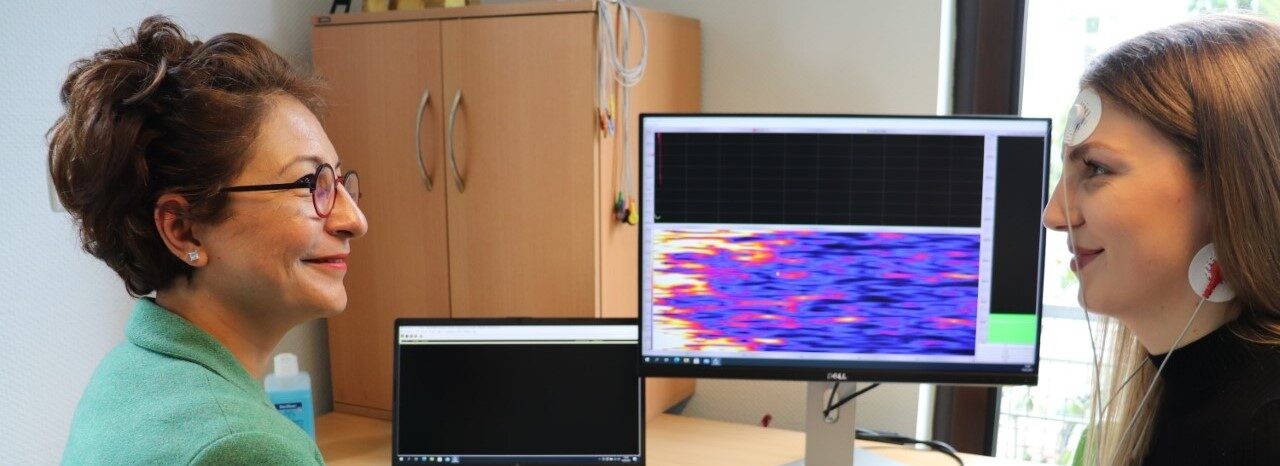
Neurofeedback trains your brain to step out of this alarm state again. We measure your brain activity and give you real-time feedback on how your brain is working. You learn to strengthen the frequencies that ensure safety and relaxation – and to reduce those responsible for vigilance and fear.
The special thing: neurofeedback works directly on the neurobiological level. You do not have to confront the traumatic experience again, talk about it in detail, or relive it. Your brain simply learns to return to a state of safety. This makes neurofeedback particularly valuable for people for whom other methods are too stressful.
Many clients report that they can sleep better again after neurofeedback training. Flashbacks and nightmares become less frequent and less intense. They can relax again without their body falling into an alarm state. They feel safer, more stable, and more present in the here and now.
The effect of neurofeedback on trauma
The effect of neurofeedback on PTSD and trauma is well documented. Many clients experience significant improvements on various levels.
Hypervigilance – this state of permanent red alert – decreases. You can relax again without your body falling into an alarm state at the slightest movement. The world appears less threatening.
Flashbacks and nightmares become less frequent and less intense. Your brain learns to process the memories of the trauma for what they are – memories, not a present threat. You can sleep peacefully again.
Emotional regulation improves. You are less overwhelmed by your feelings; you can recognize, label, and manage them better. The anger, the fear, the numbness – they lose their overwhelming power.
Dissociation – this feeling of being separated from yourself and your surroundings – decreases. You feel more present again, more connected with your body and your life.
Your overall quality of life improves. You can re-engage in relationships that you previously avoided. You can do things again that you previously avoided. You can live again – instead of just surviving.
Connection to psychotherapy – and why both belong together
Neurofeedback is not in competition with psychotherapy, but rather a valuable complement. Research shows that neurofeedback can significantly improve the effectiveness of psychotherapy for PTSD.
The reason: if your nervous system is permanently in an alarm state, it is difficult to absorb and implement the content of psychotherapy. Your brain is like an overloaded computer – new information simply doesn't get through. Neurofeedback calms your nervous system, regulates your brain activity, and makes you more receptive to psychotherapeutic work.
Many clients report that they can implement their therapy content much better after neurofeedback training. They can talk about the trauma without being overwhelmed by their emotions. They can apply the learned techniques because their nervous system is calmer.
How your training works
Step 1: Diagnostic session (up to 60 minutes, €150 plus VAT)
We get to know each other, discuss your situation, and measure your brain activity. I will show you how your brain works and where the imbalances lie that lead to your symptoms. You do not need to tell any details of your trauma – it is about your brain, not your story.
Step 2: Individual training plan
Based on the measurement results, we develop a training plan tailored precisely to your needs. For trauma with hypervigilance, we train different areas than for trauma with dissociation or flashbacks. You get clear goals and milestones.
Step 3: Regular sessions (75–90 minutes, €178.50 incl. VAT)
Each session begins with ergonomic and cognitive preparation – movement, posture optimization, sensory activation. This prepares your brain optimally for the neurofeedback. If required, we supplement with biofeedback for body regulation.
First noticeable changes – better sleep, fewer flashbacks, more peace – often show up after just a few sessions. Sustainable, stable effects usually develop after a longer training period.
Neurofeedback for PTSD in Berlin-Grunewald
We have experience working with traumatized individuals and know how important a safe, reliable environment is. You set the pace. You decide what you want to share and what not. Your well-being comes first.
Our goal: to help you return to a state of safety – so that your life is no longer dictated by the past.
Contact
If you would like to find out more or schedule an appointment, please feel free to call me or write to me.
Phone: +49 151 12440870
Address: Lynarstr 13 A, 14193 Berlin – Grunewald
Note: Neurofeedback is a drug-free training method and does not replace medical treatment or psychotherapy. If you have questions about its applicability to you personally, we would be happy to advise you in a personal conversation.