Neurofeedback for Migraines & Headaches in Berlin | Sustainably Reduce Frequency & Intensity
When pain rules your life – how neurofeedback can help you finally get a grip on migraines and headaches

Eveline Hedtke
Neurofeedback specialist

When every day is a battle against pain
You might know the feeling: a dull pressure that slowly builds up. A stabbing pain that makes your thoughts blur. Light becomes unbearable, every noise hurts, movement is barely possible. A migraine attack can paralyze your entire day – or even several days. And you never know when the next one is coming.
Headaches are among the most common health problems of all. Migraine affects up to 14 percent of women and eight percent of men. Many sufferers turn to painkillers, often in increasing doses – and sometimes end up in a downward spiral of medication overuse and even more headaches.
The good news: There is a way that does not require medication and helps your brain to regulate itself from the ground up. Neurofeedback is one of the few non-drug methods that have been recommended in international guidelines for migraine prophylaxis for decades. It can sustainably reduce the frequency and intensity of your headaches – and give you your life back.
What happens in the brain during migraines and headaches?
A migraine is not an ordinary headache. It is a neurological disorder accompanied by altered cortical excitability. Your brain reacts oversensitively to sensory stimuli – light, noise, movement – and can no longer filter them properly. The result: a constant state of high alert that discharges in pain.
In tension headaches, muscular tension in the neck and shoulder area often plays a central role, which in turn is promoted by chronic stress. Your nervous system is caught in a vicious cycle: stress leads to tension, tension leads to pain, pain leads to even more stress.
This is exactly where neurofeedback comes in. It trains your brain to break out of this vicious cycle, stabilize cortical excitability, and reduce oversensitivity to sensory stimuli.
How neurofeedback helps with migraines and headaches
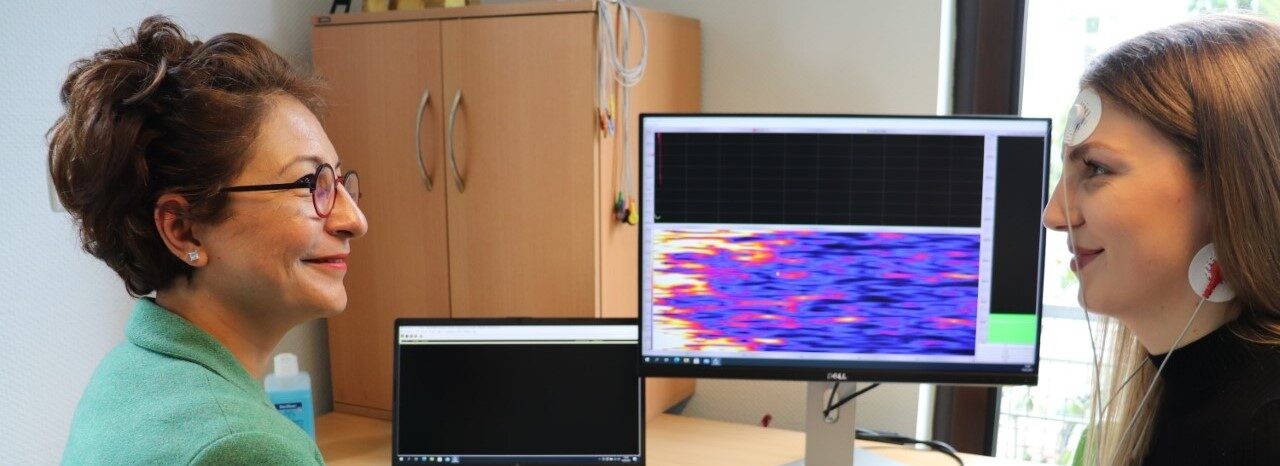
Neurofeedback is not a drug treatment that suppresses symptoms. It is a training that helps your brain to self-regulate. We measure your brain activity and give you real-time feedback on how your brain is working. You learn to strengthen the frequencies that ensure relaxation and stability – and to reduce those that lead to overarousal and pain.
A central approach is the modulation of occipital alpha activity, as many migraine patients exhibit altered visual stimulus processing. Other protocols train the regulation of specific frequency patterns in frontal and sensory networks. In parallel, pain perception is re-evaluated in the brain.
The targeted building of SMR activity calms the thalamocortical network, which is considered overexcited in migraines and tension headaches. This stabilizes information processing in the brain and reduces neuronal oversensitivity to sensory stimuli.
Many clients report that the frequency of their migraine attacks decreases significantly. The attacks become less frequent, shorter, and less intense. The quality of life also improves noticeably.
What neurofeedback can achieve for migraines and headaches
The effect of neurofeedback on migraines and headaches is diverse and well-documented.
The frequency of attacks can be significantly reduced. Numerous studies report a significant decrease in the frequency of attacks in migraines. For many clients, attacks become less frequent and shorter.
The intensity of the pain decreases. Many clients report that their headaches become less severe and they can cope with them better. Subjective pain perception also changes.
The need for painkillers can decrease. Because attacks become less frequent and less intense, many clients use medication less often – and thus avoid the dangerous spiral of medication overuse.
Stress resilience improves. Stress is one of the most common triggers for migraines and headaches. Neurofeedback trains your nervous system to react more calmly to stress. You become less susceptible to stress-induced headaches.
Overall quality of life increases. Less pain, more energy, more clarity – this has an impact on all areas of your life.
Biofeedback as a supplement – keeping an eye on your body
In addition to neurofeedback, biofeedback also plays an important role in migraine and headache therapy. In biofeedback, specific bodily functions are measured and fed back to you. EMG biofeedback of the forehead and neck muscles, temperature biofeedback of the fingers, and biofeedback of heart rate variability are particularly well researched.
Since many migraine patients show increased muscular tension or impaired stress regulation, these methods are highly relevant. Through targeted training, you learn to influence these processes. Meta-analyses show that biofeedback can reduce migraine frequency just as effectively as many established drug prophylaxes.
In our clinic, we often combine neurofeedback and biofeedback – because the brain and body are inseparably connected.
How your training works
Step 1: Assessment Session (up to 60 minutes, €150 plus VAT)
We get to know each other, discuss your headache history, and measure your brain activity. I will show you how your brain works and where the imbalances lie that contribute to your headaches.
Step 2: Individual Training Plan
Based on the measurements, we develop a training plan tailored exactly to your needs. For migraines with visual oversensitivity, we train different areas than for tension headaches with muscular tension. You get clear goals and milestones.
Step 3: Regular Sessions (75–90 minutes, €178.50 incl. VAT)
Each unit begins with ergonomic and cognitive preparation – movement, posture optimization, sensory activation. This optimally prepares your brain for neurofeedback. If needed, we add biofeedback for bodily regulation.
First improvements are often noticeable after 6 to 8 sessions. For a stable long-term effect, we recommend 20 to 30 sessions. The effects can remain stable for years.
Neurofeedback for Migraines in Berlin-Grunewald
Our goal: to help you get your headaches under control in the long term – without medication, with a method that strengthens your brain and gives you your life back.
Contact
If you would like to find out more or book an appointment, please feel free to call or write to me.
Phone: +49 151 12440870
Address: Lynarstr 13 A, 14193 Berlin – Grunewald
Note: Neurofeedback is a drug-free training method and does not replace medical treatment. For queries regarding applicability to you personally, we would be happy to advise you in a personal conversation.