Neurofeedback for emotional dysregulation in Berlin | Less anger, more stability – managing emotions better managed
How neurofeedback helps you regain control of your emotions

Eveline Hedtke
Neurofeedback specialist

When you feel at the mercy of your emotions
You might know the feeling: a small thing completely throws you off balance. An thoughtless comment, a little thing that goes wrong – and already it boils up inside you. You react impulsively, perhaps too loudly, perhaps too harshly. Later you regret it, but at that moment you couldn't restrain yourself.
Or, conversely, you slip into a deep sadness that seems to come out of nowhere. You feel overwhelmed, hopeless, empty – and you don't know why. These mood swings are exhausting, both for you and for those around you.
Perhaps you also find it difficult to recognize your feelings at all. You only feel a diffuse tension, a sense of restlessness or emptiness – but you can't name it. Your emotions are like an unfathomable chaos that controls you, instead of you controlling it.
Emotional dysregulation is not a character flaw, nor is it a lack of willpower. It is a signal from your nervous system – a signal that the connection between the controlling and emotional areas of your brain is not functioning optimally. The good news: this connection can be trained.
What is emotional dysregulation?
Emotional dysregulation means that you have difficulty regulating your feelings appropriately. Your emotions are more intense, they last longer, and they are harder for you to control.
This can manifest in various ways. You react impulsively and have outbursts of anger that you cannot explain in hindsight. You plunge into a deep sadness that you cannot escape on your own. You feel anxiety that sweeps over you, even though you rationally know there is no danger. Or you feel an inner emptiness, an emotional numbness that alienates you from yourself and others.
Emotional dysregulation is not a sign of weakness, but a neurobiological phenomenon. The areas in your brain responsible for controlling your emotions do not work optimally with the areas that generate the emotions. The connection is weakened, the communication disrupted.
How neurofeedback helps with emotional dysregulation
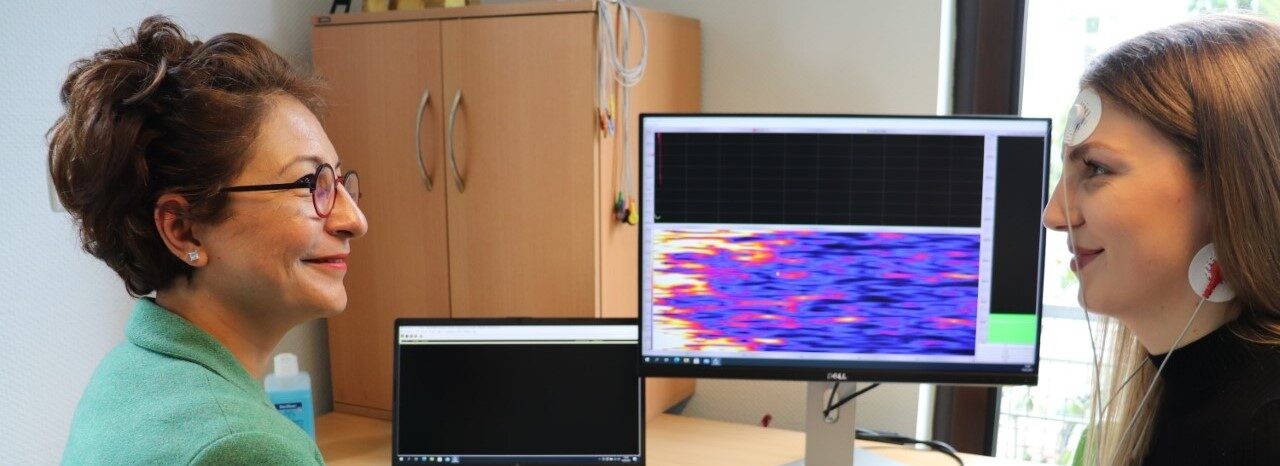
Neurofeedback trains exactly this connection. We measure your brain activity and give you real-time feedback on how your brain is working. You learn to strengthen the frequencies that provide emotional stability – and to reduce those that lead to impulsivity, anxiety, or mood swings.
You train your brain to establish new, more efficient pathways for regulating emotion. Over time, it will become easier and easier for you to manage your feelings – instead of being managed by them.
Many clients report that after neurofeedback training they can better recognize and name their emotions. They have more time between stimulus and response – they can pause for a moment and consciously decide how they want to react. They feel less overwhelmed, more stable, and more balanced.
Typical areas of application
Neurofeedback for emotional dysregulation helps with a variety of challenges.
With anger outbursts and impulsivity, neurofeedback strengthens the connection between the prefrontal cortex, which is responsible for impulse control, and the emotional centers. You learn to pause briefly and consciously decide how you want to react.
With mood swings, which are often difficult for outsiders to comprehend, neurofeedback stabilizes your emotional states. You no longer swing between extremes, but remain in a balanced middle ground.
With anxiety and panic, where intense fears appear seemingly without reason, neurofeedback calms the overactive areas in your brain. You feel less anxiety and can better handle stressful situations.
With inner emptiness or emotional numbness, when you feel cut off from your feelings, neurofeedback strengthens the connection to your own emotions. You begin to feel again and to feel alive.
With difficult relationships and conflicts, where you constantly clash or withdraw, neurofeedback improves your emotional self-regulation and thus your ability to relate to others.
Connection to the psyche – why neurofeedback is not a substitute for psychotherapy
Neurofeedback is not a competitor to psychotherapy, but rather a valuable complement. While psychotherapy works on your thought patterns, beliefs, and behaviors, neurofeedback creates the neurobiological conditions that make these changes possible in the first place.
If your nervous system is permanently in a state of alarm, it is difficult to absorb and implement the content of psychotherapy. Neurofeedback calms your nervous system and makes you more receptive to therapeutic work. Many therapists recommend neurofeedback as a meaningful addition.
This is how your training works
Step 1: Consultation and assessment session (up to 60 minutes, €150 plus VAT)
We get to know each other, discuss your challenges, and measure your brain activity. I will show you how your brain works and where the imbalances lie that lead to emotional dysregulation.
Step 2: Individual training plan
Based on the measurement results, we develop a training plan tailored precisely to your needs. For outbursts of anger, we train different areas than for anxiety or inner emptiness. You get clear goals and milestones.
Step 3: Regular sessions (75–90 minutes, €178.50 incl. VAT)
Each session begins with ergonomic and cognitive preparation – movement, posture optimization, sensory activation. This prepares your brain optimally for the neurofeedback. If needed, we incorporate biofeedback for bodily regulation.
The first noticeable changes – more calmness, less impulsivity, a more stable mood – often appear after just a few sessions. Lasting, stable effects usually develop after a longer period of training.