Neurofeedback for Autism in Berlin | Promote More Self-Regulation & Social Interaction
How neurofeedback can help children and adolescents with autism regulate themselves better

Eveline Hedtke
Neurofeedback specialist

You wish your child could go through daily life more easily
You might know the feeling: your child is overwhelmed by stimuli that others don't even notice. A loud noise, a sudden change, an unfamiliar situation – and they can no longer cope. They withdraw, scream, lash out, or fall completely silent. The world is often too bright, too loud, too unpredictable for your child. And you want to help them, but you don't always know how.
Autism spectrum disorders are neurobiological differences – not a character flaw, not a parenting mistake. The brains of autistic children and adolescents process stimuli differently, regulate emotions differently, and interact differently with their environment. This is not an illness that needs to be cured – but it is a challenge that accompanies your child and your family every day.
The good news: the brain is malleable. Neurofeedback is a drug-free training method that can help autistic children and adolescents improve their self-regulation – without changing them, without forcing them to adapt, but by giving them tools to navigate their daily lives better.
What happens in the brain in autism?
Autism spectrum disorders manifest as altered brain activity. The networking between different brain regions functions differently – some regions are overactive, others underactive, and communication between these areas is disrupted.
Areas responsible for social interaction, emotion regulation, and the processing of sensory inputs are often particularly affected. The result: your child perceives stimuli differently, reacts differently to social signals, and has difficulty regulating their emotions.
This is exactly where neurofeedback comes in. It trains those brain areas that are frequently dysregulated in autism – and helps the brain return to a more stable state. This is not a change in personality, but support for self-regulation.
How neurofeedback helps in autism
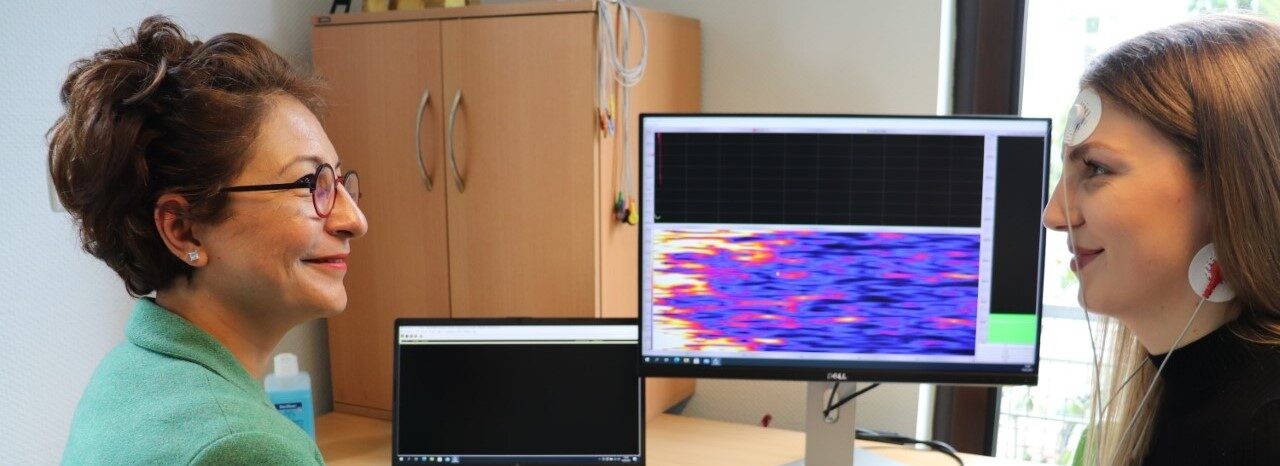
Neurofeedback is not a medication that suppresses symptoms. It is a training program that helps the brain regulate itself better. We measure your child's brain activity and give them real-time feedback on how their brain is working. Playfully, they learn to strengthen the frequencies that provide calm and stability – and to reduce those that lead to overarousal and stress.
Research shows promising results. A 2025 systematic review analyzed 12 studies on neurofeedback in autism and found that 83 percent of the studies showed a positive effect on cognitive functions. Improvements were particularly observed in the areas of attention, memory, executive functions, and language.
The long-term effect is also documented: six of the analyzed studies demonstrated sustained improvement in cognitive functions.
What neurofeedback can achieve in autism
The impact of neurofeedback in autism is diverse – and it shows in the areas that are particularly important for your child's daily life.
Executive functions can improve. A study involving 35 children with autism (ages 7 to 17) showed significant improvements in inhibitory control, cognitive flexibility, processing speed, and working memory after 30 neurofeedback sessions over 10 weeks.
Emotion regulation can be strengthened. A randomized controlled trial from 2025 investigated the training of slow cortical potentials in autistic adolescents. The results suggest that neurofeedback can influence cognitive efficiency and emotional processing.
Inhibitory control can be improved. A randomized controlled trial with 24 adolescents with autism showed that infra-low frequency neurofeedback significantly improved inhibitory control – that is, the ability to control impulses and focus on a task.
Attention span can increase. A 2024 school-based study suggests that neurofeedback can improve attention in students with autism and intellectual impairments.
Social interaction can be fostered. A 2024 review shows that neurofeedback can have a positive and significant effect on improving social interactions in children with autism.
Biofeedback as a supplement – involving the body
Autism is not just a peculiarity of the brain – it also manifests in the body. Many autistic children have difficulty feeling their bodies, regulating their breathing, or releasing tension.
That is why we often recommend combining neurofeedback and biofeedback for autism. With biofeedback, we measure heart rate variability, muscle tension, or skin conductance. Your child sees in real-time how their body reacts to different stimuli – and learns to regulate it consciously.
The combination of neurofeedback and biofeedback is particularly effective in autism because it trains both the brain and the body – thereby supporting self-regulation on multiple levels.
How training works for your child
Step 1: Consultation & Test Session (up to 60 minutes, €150 plus VAT)
We get to know your child, explain everything playfully, and conduct initial measurements. No needles, no pain – only sensors on the scalp. Your child gets a first impression of what neurofeedback feels like, and we identify the starting points for the training.
Step 2: Individual Training Plan
Based on the measurement results, we develop a training plan tailored precisely to your child's needs. For autism with severe sensory overload, we train different areas than for autism with social difficulties or motor sensory differences.
Step 3: Regular Sessions (75–90 minutes, €178.50 incl. VAT)
Each session begins with ergonomic and cognitive preparation – movement, balance, sensory activation. This optimally prepares the brain for the neurofeedback. If needed, we add biofeedback for body regulation.
Initial changes – more calm, better concentration, less overwhelm – often appear after just a few sessions. Sustainable, stable effects usually develop after a longer training period.
Our approach – movement, ergonomics, and neurofeedback
Most neurofeedback centers work classically: the child sits down, the sensors are attached, and they train on a screen. We do it differently. Before we start with neurofeedback, we prepare your child's brain with targeted movement exercises.
Because the brain does not learn in isolation – it learns within the body. That is why we use functional exercises, balance training, and sensory stimuli, inspired by the Melillo Method. This improves neuroplasticity and makes the actual neurofeedback significantly more effective.
Especially for autistic children, who often struggle with body awareness and coordination, this approach is highly valuable. The movement units are not exhausting but rather playful and challenging at the same time – and they optimally prepare the brain for training.
Neurofeedback for autism in Berlin-Grunewald
We have experience working with autistic children and adolescents – and we know how important a safe, reliable, and low-stimulus environment is. Your child sets the pace. We adapt to their needs – not the other way around.
Our goal: to help your child manage their daily life better – with more self-regulation, more confidence, and a higher quality of life.
Contact
If you would like to learn more or make an appointment, please feel free to call or write to me.
Phone: +49 151 12440870
Address: Lynarstr 13 A, 14193 Berlin – Grunewald
Note: Neurofeedback is a drug-free training method and does not replace medical treatment or psychotherapy. If you have questions about its suitability for your child, we would be happy to advise you during a personal consultation.