Biofeedback in Berlin | HRV, EMG & GSR for stress regulation & better quality of life
With biofeedback in Berlin, you can find out what is really going on inside you

Eveline Hedtke
Neurofeedback specialist

Your heart rate changes when you are stressed. Your muscles tense up without you even realizing it. Your body is constantly sending signals. The question is: Do you notice them?
Most people have forgotten how to listen to their bodies. They function, they push through their daily lives, they ignore the warning signs - until at some point their back screams, sleep no longer comes, or exhaustion takes over.
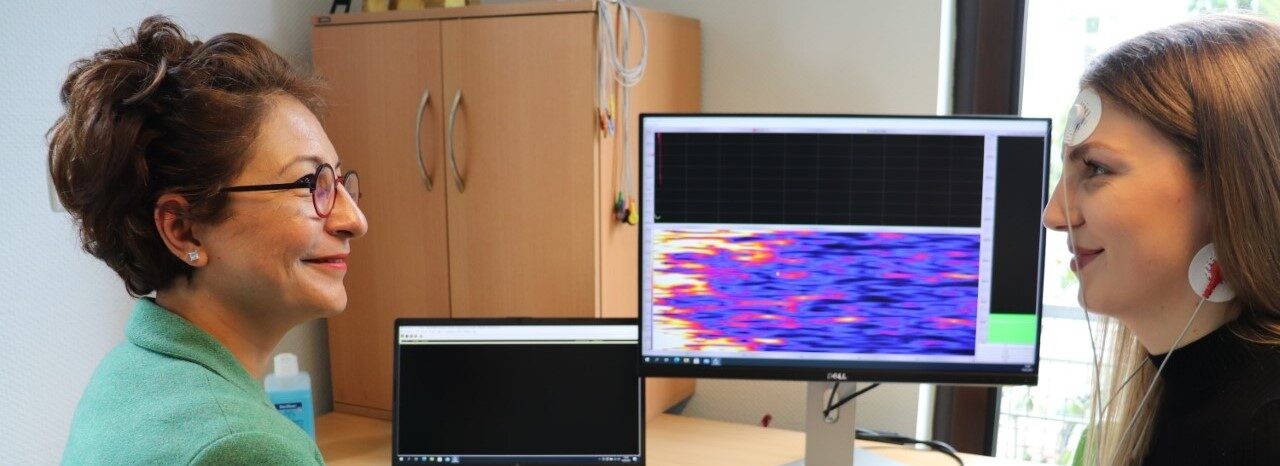
Biofeedback makes these signals visible. You see on the screen what your body is doing right now – and you learn to control it consciously.
What is Biofeedback – and how does it help you?
Biofeedback is a scientifically proven training method in which you learn to consciously perceive and influence your otherwise subconscious bodily functions. Using sensitive sensors, we measure various physiological signals – for example, your heart rate, your muscle tension, or your skin conductance – and make them visible on a screen.
You see in real time how your body reacts to thoughts, feelings, or external stimuli. And you experiment with how you can change these reactions – through breathing, relaxation, or mental imagery. Over time, you learn to transfer this ability into your everyday life: to remain calmer when pressure rises, to relax more consciously when you need to, and to understand your body as an ally – not as an enemy.
The three biofeedback methods – HRV, EMG, and GSR
Depending on where your challenges lie, we use different biofeedback methods. Each of them gives you insight into a different area of your nervous system.
HRV – Heart Rate Variability: The key to your stress resilience
Your heart does not beat evenly like a metronome. The interval between two heartbeats varies – and precisely this variation is an important indicator of the health of your nervous system. High heart rate variability means that your nervous system is flexible: it can switch quickly between tension and relaxation. Low HRV, on the other hand, indicates chronic stress, exhaustion, or overloaded regulation.
With HRV biofeedback, we measure your heartbeat and show you on the screen how your breathing, your thoughts, and your feelings affect your heart rate variability. You learn to control your breathing in such a way that your nervous system enters a state of rest and regeneration. This is particularly effective for stress, burnout, sleep disorders, and anxiety.
EMG – Muscle Tension: Recognizing and releasing tension
Many people carry their stress in their bodies – in their neck, their shoulders, their jaw, or their back. Often they do not notice it at all because the tension has become a habit. EMG biofeedback makes this hidden muscle tension visible. Using small sensors on the skin, we measure the electrical activity of your muscles.
You see on the screen when your muscles tense up – and you learn to consciously relax them. This is helpful not only for chronic tension and back pain, but also for tension headaches, migraines, or jaw problems. Many clients report that after just a few sessions, they feel for the first time what real relaxation means.
GSR – Skin Conductance: Keeping an eye on your emotional stress response
Your skin changes its conductance depending on how aroused or relaxed you are. This is because your sweat glands react to emotional and cognitive processes – often unnoticed. With GSR biofeedback, we measure these tiny changes in skin conductance on your fingers.
You see in real time how your body reacts to stressors – even before you consciously perceive it. And you learn to influence this reaction: to breathe more calmly, to center yourself, to direct your thoughts. GSR biofeedback is particularly effective for anxiety disorders, panic attacks, emotional dysregulation, and stress.
Who is biofeedback suitable for?
Biofeedback is suitable for all adults who want to improve their self-regulation – whether for stress management, performance enhancement, or the treatment of symptoms. It helps with chronic stress and burnout, sleep disorders and anxiety, chronic pain and tension, concentration problems, and emotional dysregulation. Athletes and executives also use biofeedback to optimize their performance and recover faster.
Biofeedback is not a competitor to psychotherapy, but rather a valuable supplement. It creates the physical conditions that allow psychotherapeutic approaches to really work in the first place.
This is how biofeedback works for you
Step 1: First consultation and measurement
In a personal consultation, we clarify which biofeedback method is best suited for you. Then we attach the sensors – painlessly and uncomplicatedly. You immediately see how your body reacts to various stimuli.
Step 2: Training and feedback
You try out different techniques – breathing exercises, relaxation methods, mental imagery – and see on the screen how they influence your bodily functions. You get immediate feedback on whether what you are doing is working. And you develop a sense of what a regulated state feels like.
Step 3: Transfer to everyday life
The goal is not for you to be tied to the sensors forever. Instead, it is for you to learn to transfer the skills you practice during biofeedback into your everyday life – staying calm in stressful situation, relaxing consciously, listening to your body.
Book your biofeedback session now
Give your body the chance to be heard.
Phone: +49 151 12440870
Address: Lynarstr 13 A, 14193 Berlin – Grunewald
Note: Biofeedback is a drug-free training method and does not replace medical treatment. If you have questions about its applicability to you personally, we will gladly advise you in a personal conversation.